|
|
|
|
Speaker Biographies
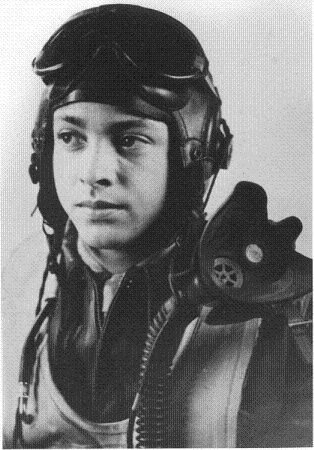
George Hardy
George E. Hardy in
March 1943, at the age of 17, passed the written and physical
examinations for the US Army Aviation Cadet program.
In July 1943 he was called to
active duty and sent to Keesler Army Air Field, Biloxi,
Mississippi, for basic training.
In September 1943 he was
assigned to the 320th College Training Detachment at
Tuskegee Institute in Alabama.
His group was scheduled to take
college-level courses, at Tuskegee Institute, for a period of
five months. This training was cut short in He attended New
York University, School of Engineering, in the Bronx, from
September 1947 to May 1948. He was recalled to active duty at
Lockbourne Air Force Base (LAFB), Ohio, in June 1948.
He was assigned to the 301st
Fighter Squadron, 332nd Fighter Group, flying P-47
aircraft.
In September 1948 he was
reassigned as a student in the Airborne Electronics Maintenance
Officers Course at Keesler AFB, Mississippi.
The course of study covered
radar and long-range navigational equipment on fighter and
bomber aircraft.
He graduated in August 1949.
In July 1949 the USAF
instituted racial integration and personnel at Lockbourne AFB
were reassigned to Air Force bases worldwide.
After graduation in August
1949, he was transferred to the 19th Bomb Group (B-29
Aircraft) on the island of Guam. He was further assigned to the
28th Bomb Squadron as a maintenance officer. His
primary job was supervising about 25 airmen in maintenance of
electronic equipment on the assigned aircraft.
As a pilot he was also required
to fly and was assigned as a copilot on a B-29 aircrew.
The Korean War started 25 June
1950, and the 19th Bomb Group was transferred to
Kadena Air Base, Okinawa. He flew 45 combat missions over Korea
in the B-29 aircraft. In March 1951 he
returned to the states and was assigned to 6th Bomb
Wing, at Walker AFB in New Mexico, as a maintenance officer. In
June 1951 he was transferred to Lowry AFB, Denver, Colorado for
seven months training as an Armament Systems maintenance
officer, specifically on B-36 aircraft.
The B-36 aircraft was the
largest aircraft in the Air Force, capable of intercontinental
bombing missions without refueling.
The armament systems field
included not only the electronic navigational and bombing
systems but also included the retractable gun turrets and
maintenance and loading of the bomb bays.
After the training at Lowry he
was transferred back to Walker AFB and in December 1952 he was
transferred to Carswell AFB, Ft Worth, Texas. He became part of
the 42nd Bomb Wing (B-36 aircraft) and in March 1953
the wing was transferred to Limestone AFB, Maine. He served as a
maintenance officer in the 42nd Armament and
Electronics Maintenance Squadron (AEMS), until August 1955. In August 1955 he
transferred to the United States Air Force Institute of
Technology at Wright Patterson AFB, Dayton Ohio.
He entered the undergraduate
engineering program and in August 1957, received a Bachelor of
Science Degree in Electrical Engineering. In September 1957
he was assigned to the 3rd AEMS, 3rd Bomb
Wing (B- 57, Canberra aircraft) at Johnson Air Base, Japan.
He was soon assigned as
Maintenance Supervisor, a position he held for almost 3 years.
The 3rd Bomb Wing
areas of operations were in
Japan, Korea and Okinawa. He became jet-qualified as a pilot and
in 1959 he received the aerial rating of Command Pilot. In November 1960
he transferred to Plattsburgh AFB, New York.
He was assigned as Squadron
Commander of the 4108th AEMS, in the 4108th
Air Refueling Wing (KC–97aircraft).
In the second half of 1962 his
squadron held the 8th Air Force trophy for best AEMS
squadron.
In November 1962 he was
notified by the Air Force Institute of Technology of his
eligibility to apply for a new graduate level systems
engineering course specializing in reliability engineering.
He applied for the course and
was reassigned, in January 1963, to the USAF Institute of
Technology, at Wright Patterson AFB, Dayton Ohio.
In August 1964 he graduated
with a Master of Science Degree in Systems Engineering -
Reliability. In September 1964
he was assigned to the Electronic Systems Division of Air Force
Systems Command, at
Hanscom
AFB, Massachusetts.
In 1965 he received his
promotion to the grade of Lt. Col.
In August 1966 he was assigned
as Chief of Engineering and Program Manager, for the
Development, Installation and Cutover of the 490L Overseas
AUTOVON (AUTOmatic VOice Network) Communications Switches, part
of the Department of Defense first worldwide direct dial
telephone system.
The AUTOVON services within the
continental United States was provided by the various telephone
companies.
With completion of the overseas
switches, the Department of Defense and other government
agencies would have almost worldwide, direct dial telephone
access.
The initial sites in Europe,
Panama and the Pacific were successfully cut over in 1969. At the end of
1969 he received notice of a flying assignment in Vietnam and
was provided with refresher flight training as an AC-119K
Gunship Aircraft Commander. He was assigned to the 18th Special
Operations Squadron at Phan Rang Air Base in Vietnam in April
1970.
Although the squadron
headquarters was at Phan Rang Air Base, the aircraft were
located at two operating locations, one at Udorn Air Base, in
Thailand, and the other at DaNang Air Base in Vietnam.
He was assigned as the
Operating Location Commander at Udorn Air Base, Thailand through
August 1970.
Missions were flown at night
over northern Laos searching for truck traffic from North
Vietnam.
In September 1970 he was
transferred to DaNang Air Base in Vietnam as Operating Location
Commander.
Missions were flown at night
over central portions of Laos looking for truck traffic from
North Vietnam.
He flew 70 combat missions
before returning to the states in April 1971. In May of 1971 he
was assigned to the Inspector
General's office at Air Force Systems Command,
Andrews AFB in Maryland.
He served in the IG's office
until November 1971 when he retired with the rank of Lieutenant
Colonel. His decorations include the Distinguished
Flying Cross with Valor, the Air Medal with eleven (11) Oak Leaf
Clusters, and the Commendation Medal with one Oak Leaf Cluster.
|
|