 |
|
|
|
Speaker Biographies
Russell Gackanbach WWII
Russell Gackenbach never anticipated the notoriety he received for a single bombing mission.
Mr. Gackenbach was born and raised in Allentown, Pa. Shortly after graduating from Allentown High School in 1941 he was employed as an inspector of bomb and shell casings at Bethlehem Steel Co. As he had an interest in aviation, Mr. Gackenbach enlisted as a private in the Army Aviation Cadet Program and was called to duty Jan. 30, 1943. After completing navigation training at Pan American Airways in Miami, he received a commission as second lieutenant and wings as a navigator Feb. 12, 1944. He later attended radar school in Boca Raton. On July 6, 1944, he was assigned to the 504th Bomb Group at Fairmont Army Air Field in Nebraska and was assigned to the 393rd Bomb Squadron, where he became navigator/radar operator for a crew flying B-17 aircraft. In September, the entire 393rd Bomb Squadron was transferred to Wendover Army Air Field in Utah. "The bomb squadron was picked up lock, stock and barrel and moved near the end of the Great Salt Lake Desert on the Utah/Nevada border," Mr. Gackenbach said. "That place was selected because it was isolated." The first order of business was a meeting with the squadron's new commanding officer, Col. Paul Tibbets. "He assembled us inside the main gate of the air base, then he told us that what we were going to be doing would be different, and if successful, it would shorten the war," Mr. Gackenbach said. "Then he told us we would be under tight security. He pointed to a sign that said, 'What you hear here, what you see here, when you leave here, let it stay here.' They only told us what we needed to know do our job, and we didn't know what our job was." Col. Tibbets concluded the meeting with some good news: The men were being given a 10-day leave. "The purpose was to have us investigated," he said. "Those who didn't pass muster were transferred, which was typical of the army." The men returned and got down to work. First, the planes they would be flying, the B-29s, were stripped of all exterior guns except the tail gun. "By doing that it meant we could fly higher, faster and farther, and we could carry a heavier bomb load," Mr. Gackenbach said. The men participated in training missions from the fall of 1944 through June 1945. They were never informed of what their actual mission would ultimately be, Mr. Gackenbach said. "We had no idea what our mission was," he said. "We just made training missions all around the country, most at night, some short, some long, and we dropped bombs of various sizes." In late June 1945, the squadron moved to the Island of Tinian in the Pacific Ocean, which was taken from the Japanese in February of that year. The men were placed under tight security at the base, where no one without clearance was allowed in without an escort. There, they began preparations for loading enormous bombs into their low-lying B-29 planes, which stood only about 18 inches off the ground. "Our bombs were so big they could not be put in underneath," Mr. Gackenbach said. "We had to dig a pit in the ground, install a hoist, roll the bomb onto the hoist, lower it, roll the plane over the pit, and raise the bomb into the plane." On Aug. 2, 1945, the squadron was called into a top-secret briefing. Before they entered the briefing room, they were frisked and asked to empty their pockets. The process was repeated when they left the meeting. "Here's where we were told what the targets were," Mr. Gackenbach said. "Hiroshima, Kokura and Nagasaki, in that order." On the evening of Aug. 5, 1945, the soldiers met for the final briefing prior to the mission to Hiroshima. Again, they were told nothing of the type of payload they were carrying. On Aug. 6, 1945, three planes from the 393rd Bomb Squadron took off separately from Tinian - the famed Enola Gay, piloted by Col. Tibbets, carrying the 10-foot-long, 28-inch circumference, 10,000-pound atomic bomb "Little Boy;" the Great Artiste, charged with parachuting blast measurement devices to obtain scientific data after the bomb was deployed; and the Necessary Evil, whose men were to photograph the bomb's deployment and resulting explosion, and on which 2nd Lt. Gackenback acted as navigator. "We took off early in the morning, and flew individually to Iwo Jima," Mr. Gackenbach said. "There we met up in the familiar triangular formation, with the Enola Gay in the front, the Great Artiste on the right and the Necessary Evil on the left. We went up to altitude and flew in that formation until the IP (initial point). At the IP, plane 1 (Enola Gay) and plane 2 (Great Artiste) continued on. We (Necessary Evil) stayed behind and made a controlled circle. "As we were coming out (of the controlled circle), we were heading toward Hiroshima, when the Enola Gay dropped the bomb." The blast cloud could be seen from more than 200 miles away. Mr. Gackenbach took out his Agfa 620 camera. "Then I took that photo," he said, pointing to a grainy picture of a towering smoke plume, "from about 30,000 feet, about 12 miles from ground zero about one minute after detonation." Mission accomplished, the squadron returned to Tinian, the first tingling of ramifications setting in. "Our first reaction was stunned silence aboard the airplane," Mr. Gackenbach said. "Normally, when we went on a bombing mission, there was a lot of chatter going on (after the bombing). It was a quiet trip back to Tinian. When we got back, there was a big fuss made." When they landed, Col. Tibbets was met by four-star Gen. Carl A. Spaatz, and pinned with the Distinguished Service Cross. The others received the Air Medal for their participation. "The next day, we found out what kind of bomb we dropped," Mr. Gackenbach said. "They didn't tell us directly; we read it in the newspaper." Three days later, on Aug. 9, 1945, the Enola Gay departed for Nagasaki to release another destructive payload, called "Fat Man." The Japanese surrendered on Aug. 14, 1945. Looking back, Mr. Gackenbach said he has no reservations about his participation. "I have no regrets for what I did," he said. "We were at war, and if the Germans or Japanese had gotten (the atomic bomb technology), they would have used it." The 83-year-old retiree, one of only six surviving squadron members, said when he and the others meet for annual reunions, the talk is not of the mission or of regrets. "When we go to reunions, we don't talk about what we did at Hiroshima and Nagasaki," he said. "We talk about our experiences and our training and our personal relationships with one another."
|
|
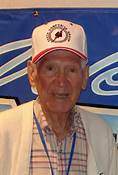 Mr. Gackenbach participated in arguably the single act that ended
World War II - the atomic bombings of Hiroshima and Nagasaki, Japan.
Mr. Gackenbach participated in arguably the single act that ended
World War II - the atomic bombings of Hiroshima and Nagasaki, Japan.